

On a crisp Friday afternoon, gaggles of school children flood down Orchard Street past the window install of Below Grand, populated by the work of the late Gary Leib. Underground comics aficionados may know him for his series Idiotland, coauthored and illustrated by his friend Doug Allen, audiofiles heard him in Rubber Rodeo, and animation fans could catch spots from his studio Twinkle. And today a new generation is getting an introduction via the festive display that usually adorns mainstay Desert Island Comics. His charming witches, skeletons, black cats, and all things spooky emanate a welcoming glow regardless of the time, though they are best experienced after dusk when black-lights illuminate wonky smiles of melting pumpkins and skulls. Seeing the kids who rubberneck to catch a full view of this little Halloween spectacular in all of its handily made glory is a reminder that holiday spirit takes root far before cynicism can redirect us.
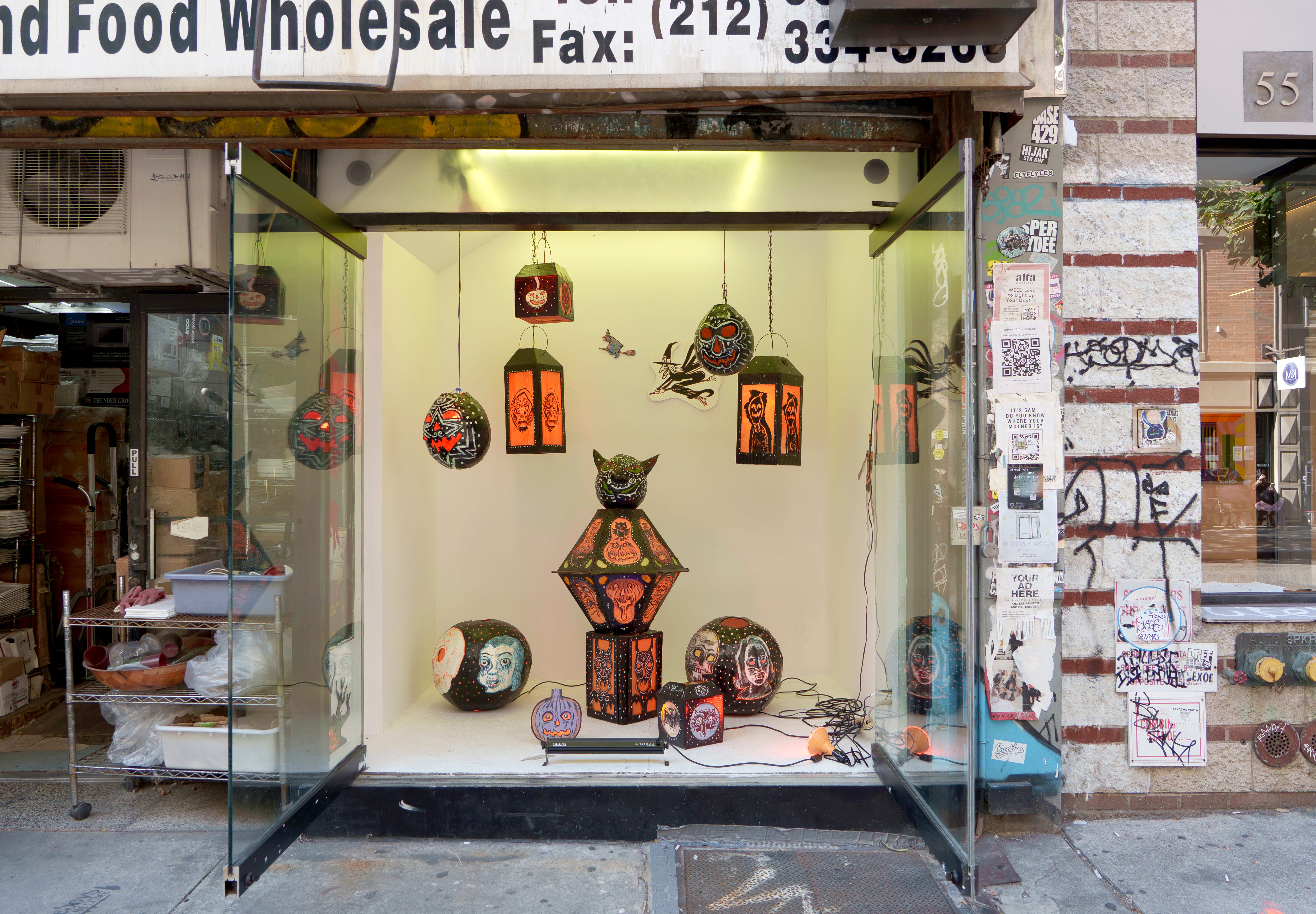
In the midst of the bustle, is curator and multidisciplinary artist Arthur Peña, down to spin a yarn for those who are old enough to view the more ghoulish works exhibited in the main gallery space. The clandestine layout adds a layer of mystique to the work that Peña brought together. Visitors are required to make their way past a wholesale restaurant supply shop in order to take in the show, making it feel like a back room deal (all that’s missing is the beaded curtains). To set the mood, he offers the poignant framing statement, “My heart is a haunted house. The world is a haunted house.” Truthier truth is hard to find these days as we watch the world burn with little idea of how to effectively put out the flames.
Peña draws inspiration from graphic artistry for his own practice, making his sensitivity and appreciation for his forebearers an incredible resource. By presenting these comic artists in a white cube, the aesthetic barriers between low and high brow are removed, so that the craft and the alchemy of monstrosity can shine through. Every monster is a metaphor, though many dismissive taste makers may fail to see beyond the tentacles to what grotesque imagery may reveal about our societal ills. Perhaps as we draw nearer to all hallows eve, the veil that obscures haunting subtexts will be thin enough for the catharsis to find the cool kids too.
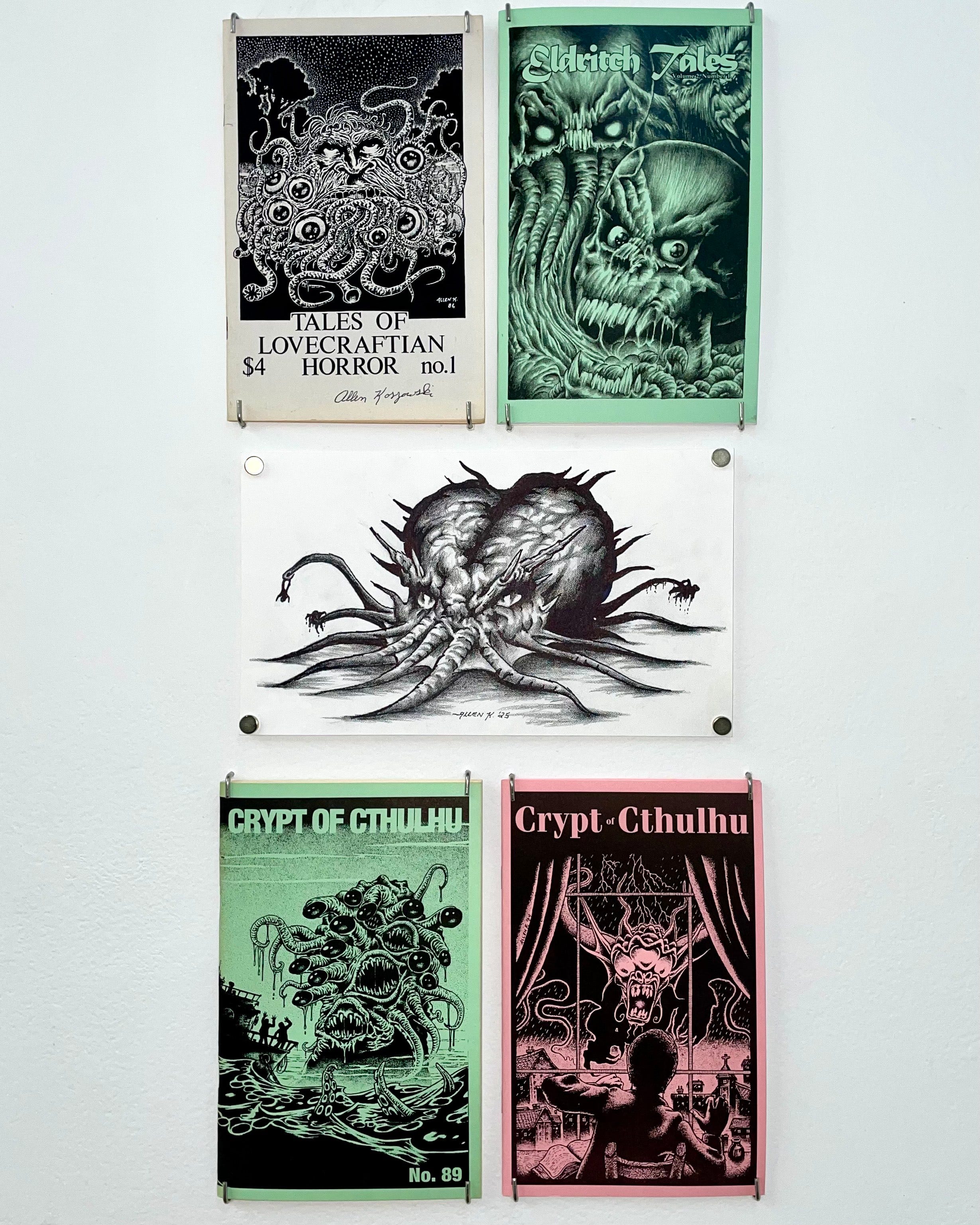
Regardless, when you hear biographical details about an illustrator like Allen Koszowski it’s easy to fill in the blanks for why a Vietnam veteran who received a Purple Heart may turn to depicting Eldritch Horror. He has been so prolific since his initial publishing in 1973, that this L. Ron Hubbard Illustrators of the Future Awardee can claim some credit in crafting our contemporary understanding of the anatomy of Cthulhu. A comprehensive collection of his work was published by Centipede Press in 2022, but you can see his work included in Isaac Asimov’s Science Fiction Mag, Weird Tales, The Horror Show, Cemetery Dance, among other publications. And his original rapidograph drawing included in the show is well worth pulling a magnifying glass on, because the textured stippling is a masterful example of draftsmanship.
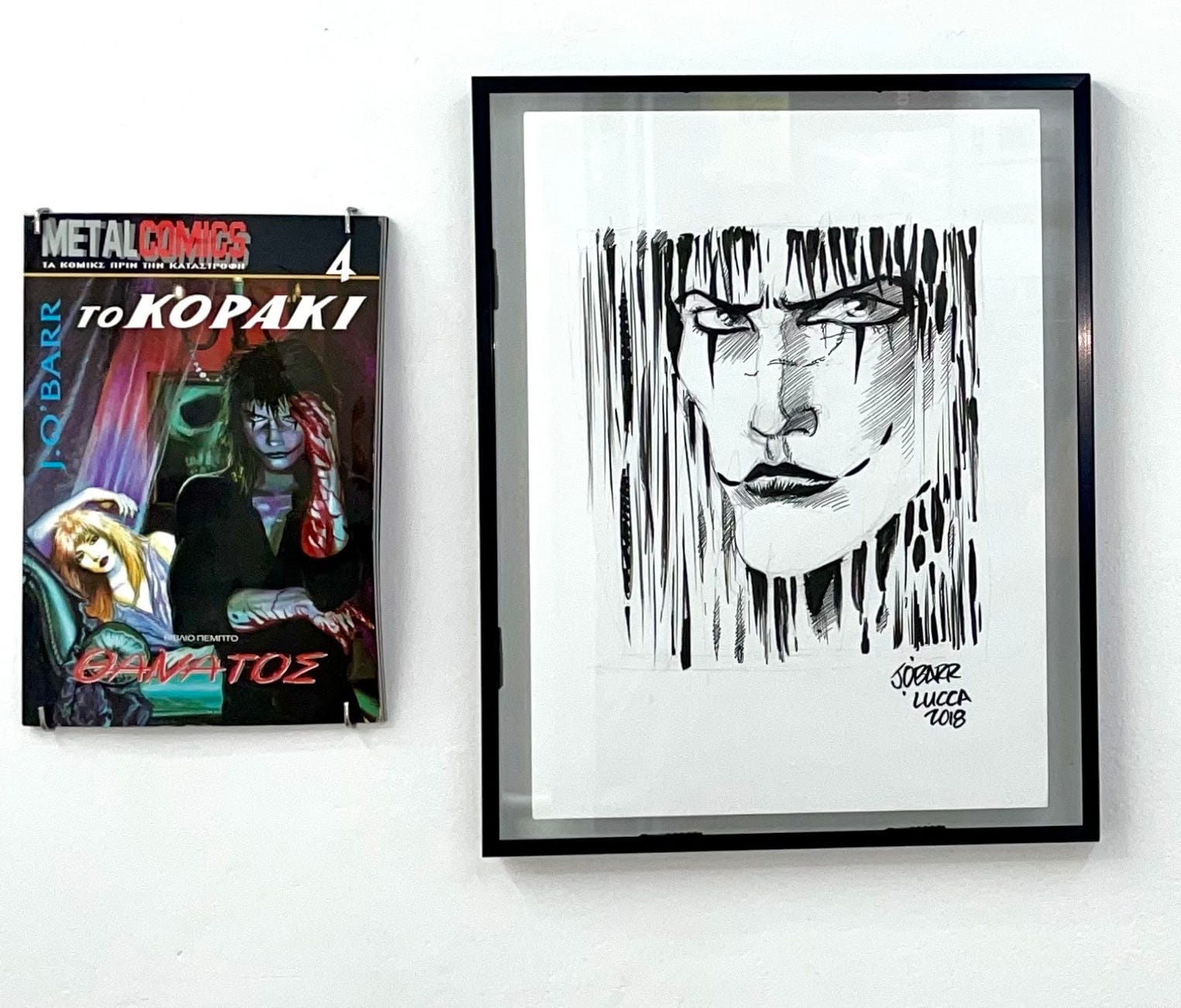
James O’Barr offers another form of transcendence through his creation of The Crow graphic novel. Raised in the foster care system of Detroit, and later enlisted in the Marines, O’Barr maintained drawing as an outlet for a life marked by personal tragedy. He enlisted after his wife Beverly was killed in a drunk driving accident, but it wasn’t until he began his black and white indie series in 1981 while living in West Berlin that he was able to channel his pain into a work that would later win the Academy Award for Comics in 1995 in Italy. Of course goth kids may have been introduced to The Crow through a screen adaptation starring the cursed Brandon Lee who left us with this haunting last interview before he was taken down by a prop gun malfunction. He quoted from Paul Bowles’ book The Sheltering Sky which he used for his wedding invitations, and is now on his tombstone:
“Because we don’t know when we will die, we get to think of life as an inexhaustible well. And yet everything happens only a certain number of times, and a very small number really. How many more times will you remember a certain afternoon of your childhood, an afternoon that is so deeply a part of your being that you can’t even conceive of your life without it? Perhaps four, or five times more? Perhaps not even that. How many more times will you watch the full moon rise? Perhaps twenty. And yet it all seems limitless.”
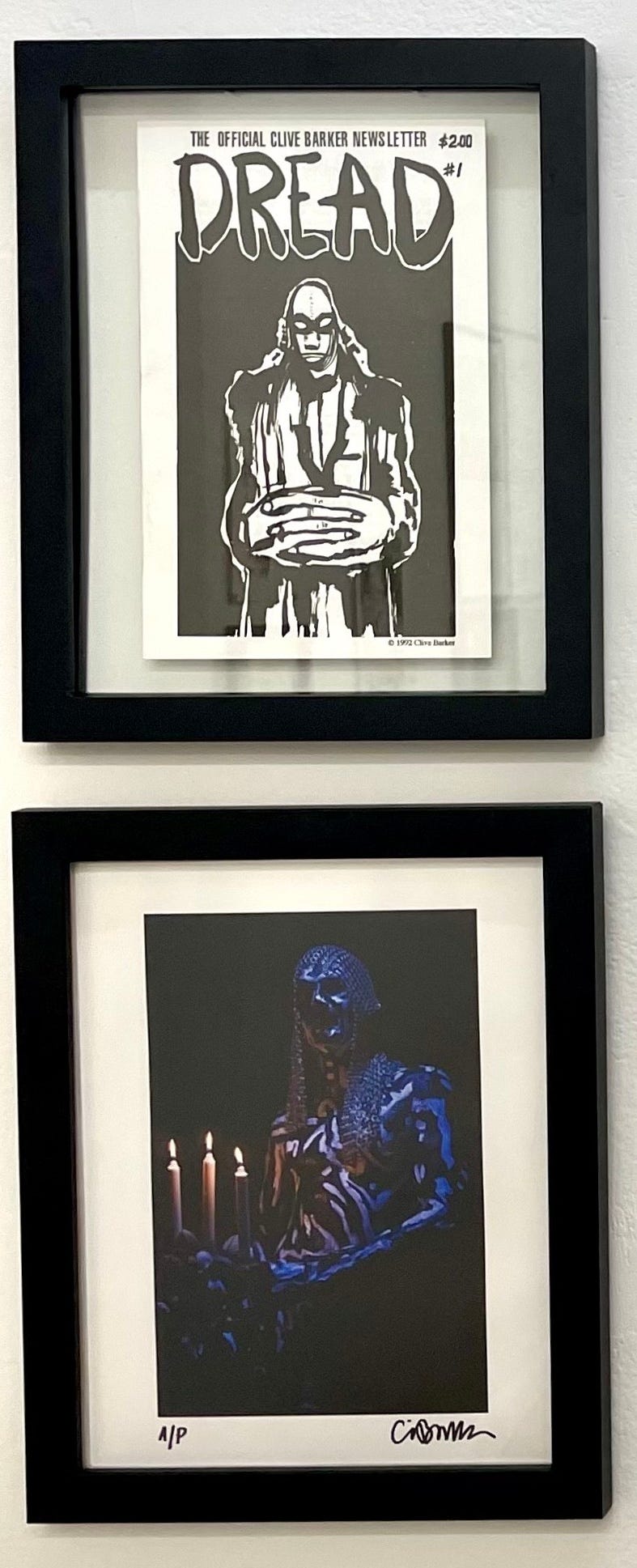
Clive Barker is possibly the most broadly known name in the bunch, with horror classics under his belt like Hellraiser, based on his book The Hellbound Heart, Nightbreed adapted from his story Cabal, and Candyman based on The Forbidden. Aside from his Academy Award nominated work in film and best selling literature, he is also an accomplished painter who exhibits widely. And to snap all of his Cenobites into focus on our earthly plain, he’s given extensive interviews about participating in sadomasochistic subcultures and work as a gay escort. But aside from tackling issues of the psychosexual variety, he is also widely praised for taking on issues of race and class in the Candyman series. For his depth in processing so many societal sticking points he was given a Lifetime Achievement Award from the Horror Writer’s Association.
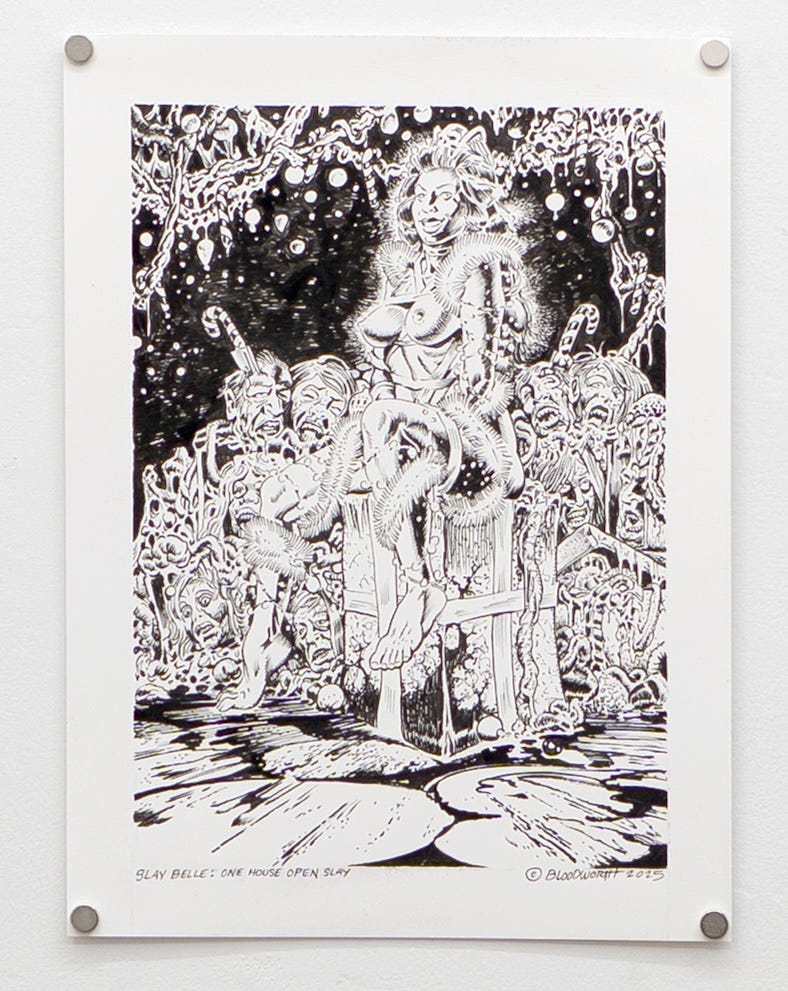
Mark Bloodworth might not have been the progenitor, but he was brought into the Hellraiser fold via Marvel Comics. A great appreciator of black and white horror comics himself, he penned an homage in 2008 called Midnight Mortuary. While his personal life is largely unspoken of, he’s had a lustrous career with Arrow Comics, working on Nightstreets and Caliber Comics working on Deadworld. Being a comic artist means having a daily practice of churning out line work like a beast, and his contribution shows that confidence in spades.
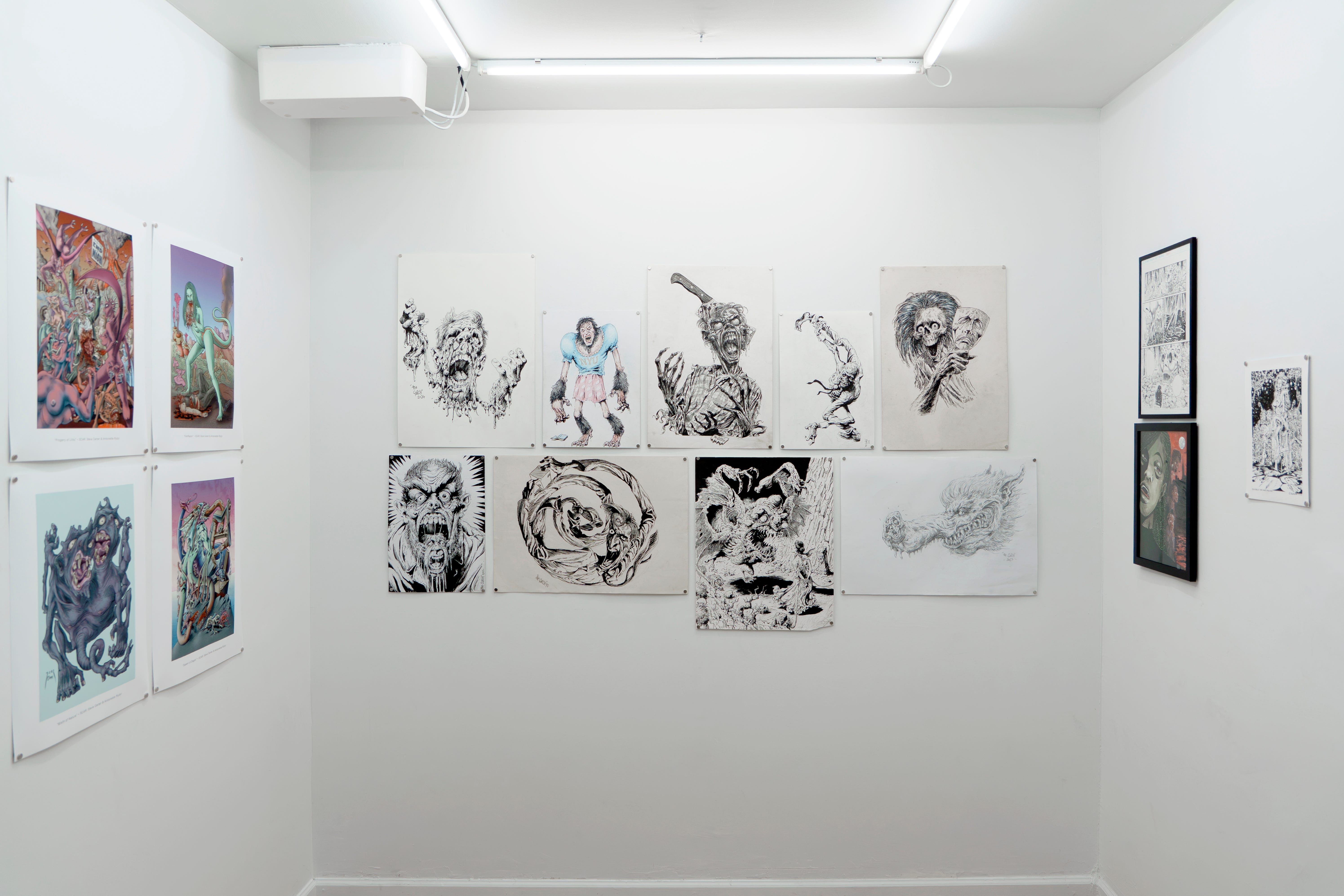
The Gurch is a horror illustrator from the deep dark abyss of the UK who makes a point of being unknowable, except by his humorous and grotesque zombies and ghouls that you couldn’t buy if you wanted to. They are not for sale. The Gurch horrifies for the love of the game, but you can find his splatterpunk work reproduced in the Gore Shriek series from 1989. He has also graced the show goers with a wall of oddities and disgusts that range from delicate wispy graphite renderings of a phallic werewolf to a self portrait of the artist as a spiraling spineless man holding a cube that could be more evidence of Hellraiser’s far reaching influence.
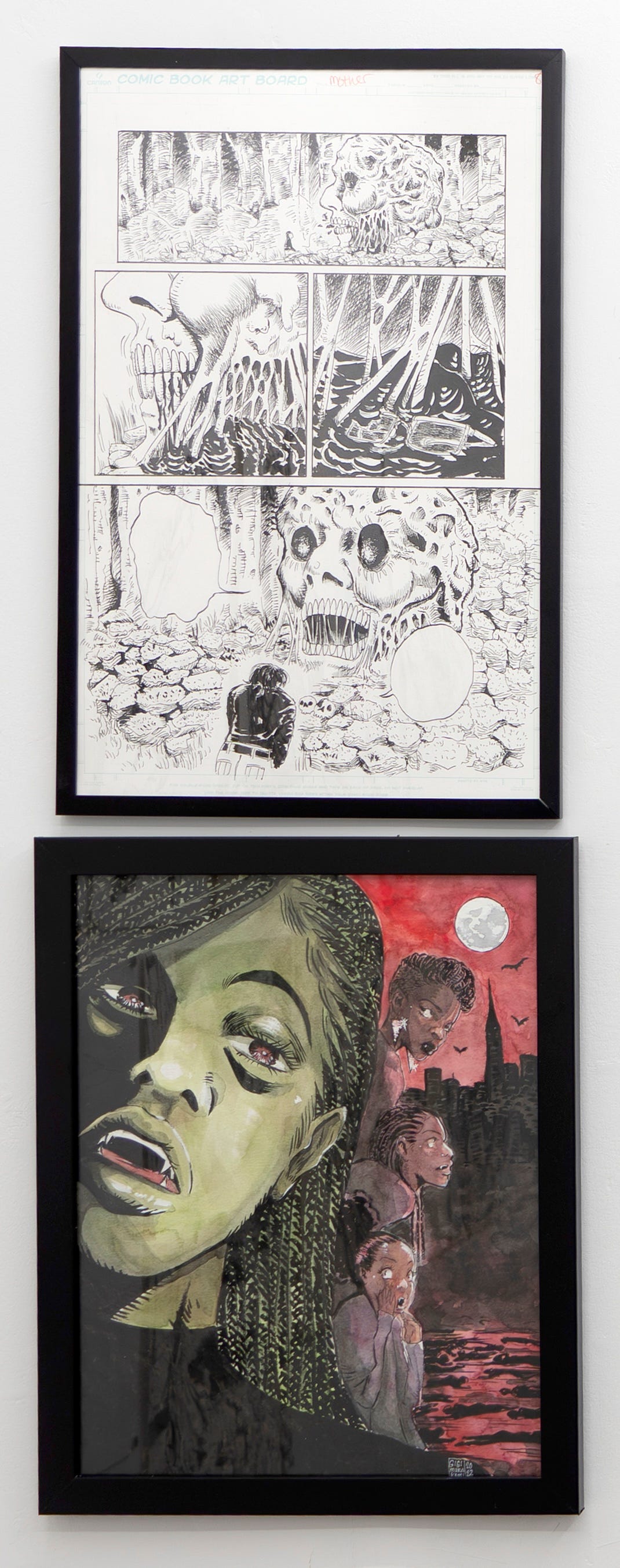
Bronx born, Ignatz-nominated manga artist Gigi Murakami offers an exciting evolution to the world of classic horror as she expands the narrative to center black women and femmes. Included in the show is a full color page of Sisters in Blood, but most will recognize her from RESENTER published by Viz Manga. In this work she tackles issues of revenge and retribution via the afterlife. Through her character Jackie (a spirit tasked with guiding people through the afterlife), Murakami is able to discuss the darker aspects of carework as well.
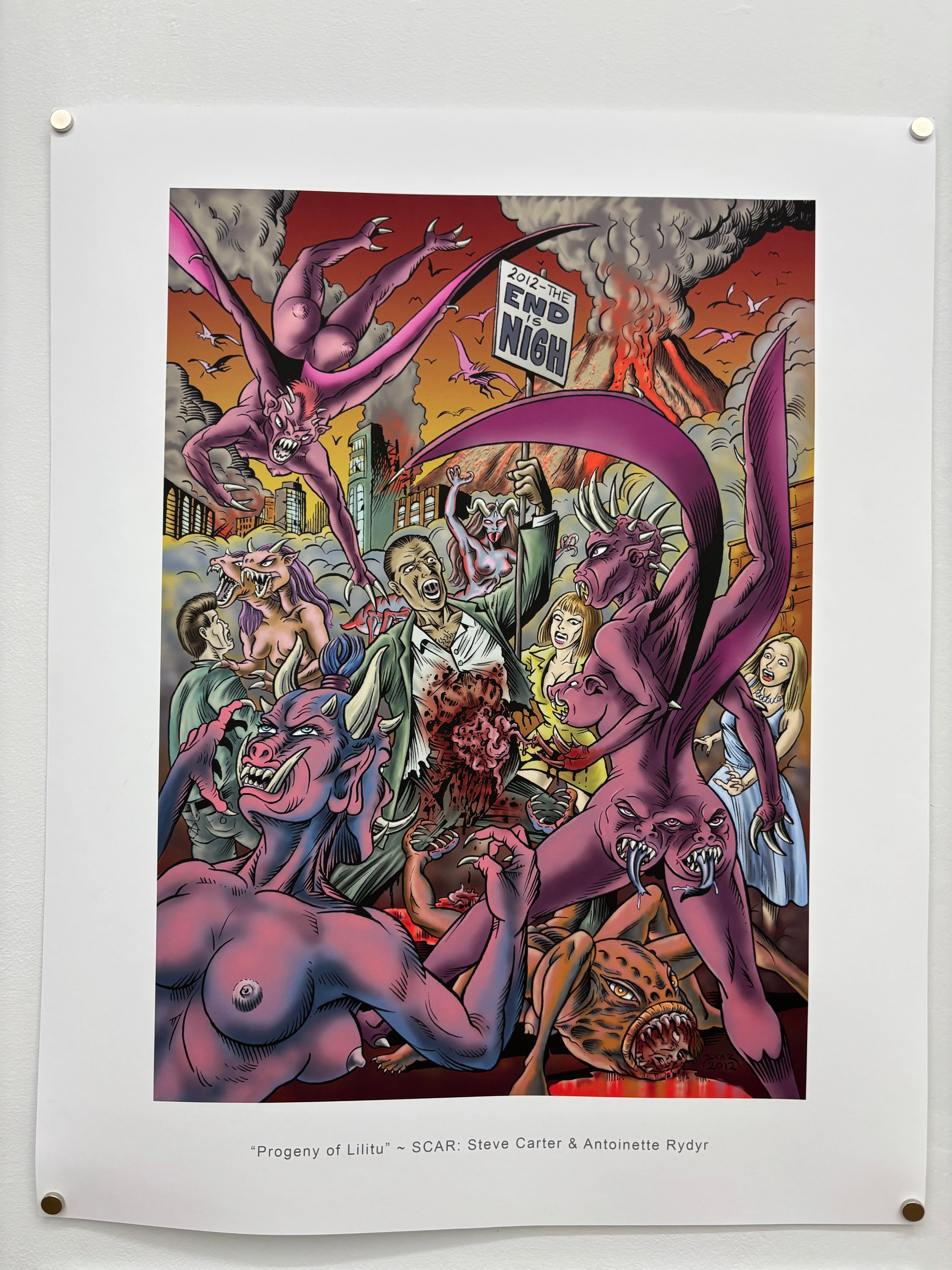
Another for the multihyphenate talent section, the duo S.C.A.R. can be found improvising electronica with Fistfunk Futurists, TeknoSadisT and Napalm Enema. At times this was easier than scoring a copy of their visual work. Steve Carter (S.C.) and Antoinette Rydyr (A.R.) had their 1990s series Spore Whores designated a “prohibited import” in Australia, their home turf, along with Phantastique in a period of moral panic. While their colorful and psychedelic work does incorporate grotesque violence and sexual imagery, it is not the type to corrupt. But beginning in the 1950s, Australian comics publisher Horowitz created a code that stated
“all writers, artists, and editors must eliminate all objectionable matter, which:
(a) Glorifies or condones reprehensible acts or characters.
(b) Is offensively “sexy”.
(c) Features illustrations which are offensively gruesome or “sexy”.
(d) Distorts facts or is in any way misleading.”
This code was in response to legislation that sought to control culture as a means to regulate the issues facing the country’s youth. Of course non-conformist art ends up being the scapegoat every time an administration can’t get their resource and service distribution in order. While the Horowitz code was loosened in the 1970s, allowing underground comix to proliferate, the gates were shut again in the 90s. And today with all the trouble sending art past the new authoritarians cropping up, we are graced with some digital copies of their absolutely hilarious mongolids.
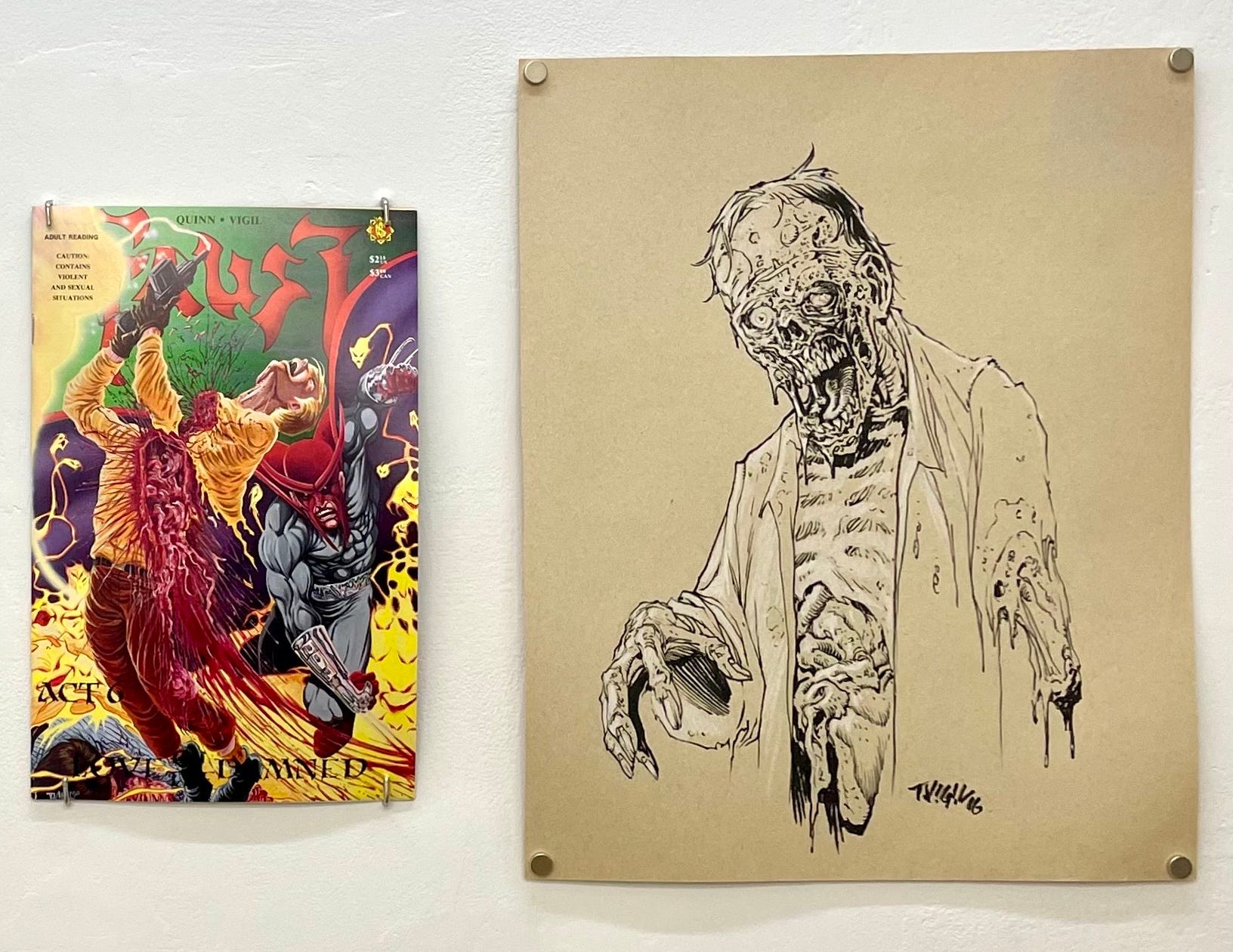
Tim Vigil is another titan of the explicit as the artist who made art for Faust (written by David Quinn) which debuted in 1988. In this reimagining of the guy who sold his soul for power was given an X rating for extreme violence and sexual imagery. Customs officials were seizing copies as they made their way to Canada and the UK, but this envelope pushing work was also targeted by the Satanic Panic back at home. The story follows vigilante John Jaspers, who sells his soul in exchange for super powers only to rise against Mephistopheles to save Dr. Jade DeCamp (his love) and win back his soul. And wouldn’t you know it, yesterday’s contraband was bought up by Sony Pictures Television in 2021. All industry gossip aside, the elegant line work Vigil brings to the Zombie on view is a real treat. And when you consider his cover for Faust, you can see how the precision in his hand lends itself to such a dense and dynamic composition, bringing the evisceration to life.
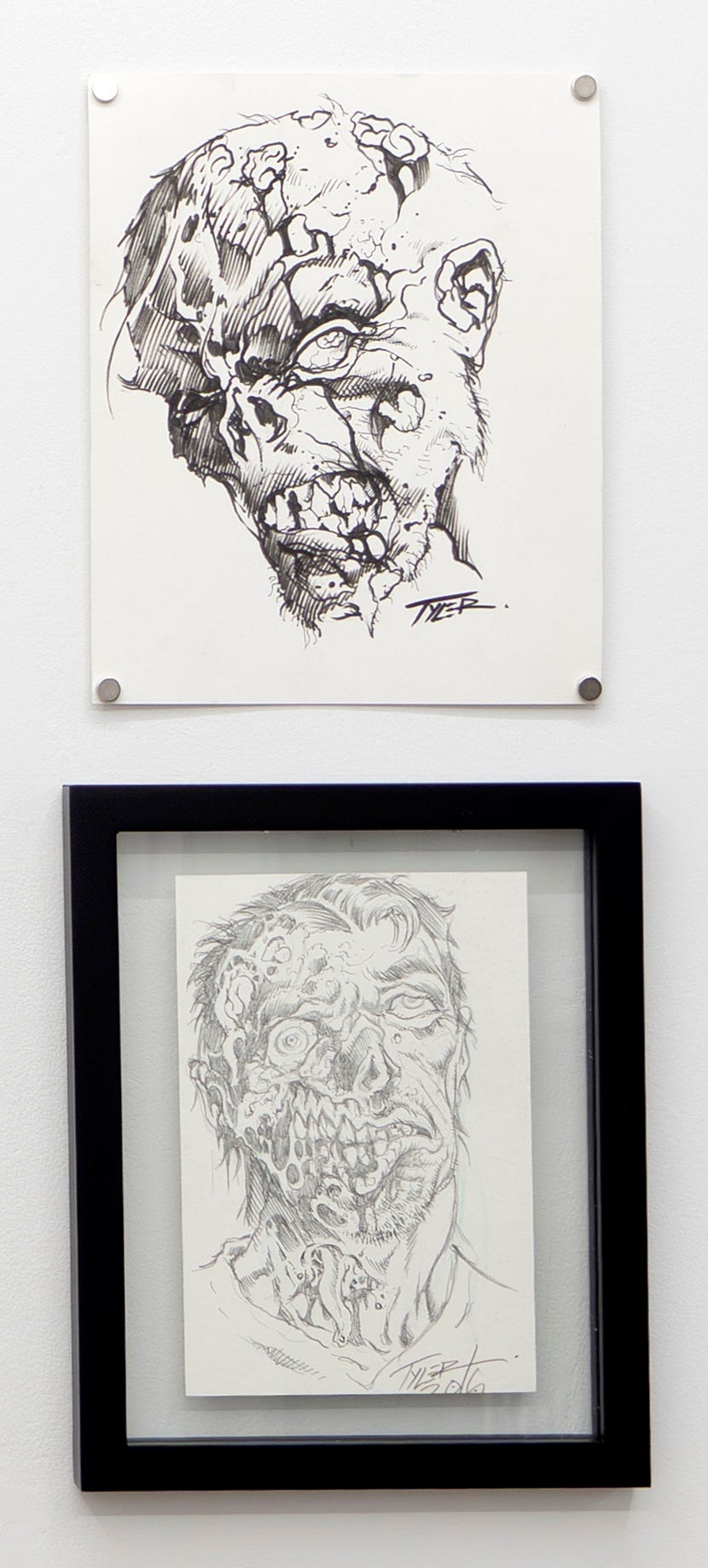
Tim Tyler is another Faust alum (inker). His art also appears in Razor (inker and early publisher) Dreadstar, Blood Reign, Devil Jack and others. While he’s worked for some small companies, he’s also done extensive self publishing under Fathom Press, Doom Theater, and most recently, Rat House Comics. Newer titles include Fiends, Engine, Bolt Theater, and the Heavy Metal Tribute magazine Grail. This is by no means his entire CV, so you can start to see that this guy is an industry juggernaut. It’s only by working tirelessly on your craft that an artist can arrive at the simplicity that he achieves with his shading on the zombie heads on view. Just think of the thousands of zombies that were rendered before these, and how smooth the drawing flow has got to be at this point.
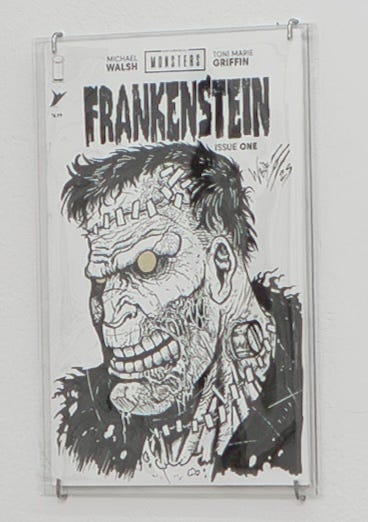
Chicago based comic book artist, illustrator, concept artist, and video game designer Maria Wolf rounds off this motley crew with her classic rendition of Frankenstein. A member of the Tarascan tribe, purepecha of Michoacán Mexico, she has done illustration work for the Smithsonian Institute National Museum of the American Indian’s “Native Knowledge 360 (KN360)” online exhibit. Her work is also published by big boys like DC, Marvel, BOOM! and Image Comics. Her extensive knowledge of classic horror and the pantheon of classic comic book heroes keeps her in high demand, and you can see why as Wolf wields a hefty line that adds pop to her rendering. And who doesn’t love a little cool guy aura in their reanimated corpses?
Whether by exposing the internal struggles of an artist, or the hypocrisies of our administrations hell bent on blaming art for problems they create, horror has a unique power to aid in catharsis. So next time you come across a ghoul or goblin, ask them for a vibe check and you may learn about how to alchemize grief or find joy amidst the terror of modern life. Art is here for us to explore the boundaries of the acceptable, and to give space to those who have lived through the unacceptable. And when you step outside of the narrow focus of the fine art establishment, you can find a world of accolades and lifetimes spent in service to an audience that truly loves what they love. This is just a reminder that you don’t need a retrospective at the Guggenheim for your art to be validated, you just need to connect directly with the community who shares your sensibilities.
Nightmares in Blood
Below Grand, 53 Orchard
Curated by Arthur Peña
Open weekends from October 4th - November 8th